


A Producer’s Dream: The Scoop on Scoop.It

Randy Lane • March 30, 2012

Scoop.It is a free publishing-by-curation platform that allows you to curate content based on keywords and sources you provide. It will suggest stories, articles, videos, news for you to scoop. You can also use the bookmarklet to scoop anything you see on the web to your Scoop.It page.

You can curate on your page and on the web, saving interesting content for your show in one place. You choose the keywords and the sources you like. Instead of searching a million websites individually, you add them here. It’s a Producer’s dream.


In October 2011, I signed up for Scoop.It to test it out before recommending to The Randy Lane Company clients. I quickly realized that not only was it worth recommending, but it would also be helpful in curating show ideas for our weekly client newsletter.

Since October, I have been using Scoop.It daily. While some of the scooped ideas are used for the weekly Content Ideas , many aren’t because they are topical and may be outdated by the time the newsletter is delivered in client emails. Because I scoop the ideas daily anyway, I began sharing my page Radio On-Air Content on Twitter so the show prep doesn’t go to waste.

I now have thirty shows following my topic. Many have created their own Scoop.It pages for show prep where they can scoop their own topics from the web and rescoop mine to their page, as well. The trend has also spread to other radio consultants, who now run their own pages on Scoop.It.

The reason other shows and consultants have taken notice? It’s easy to use and it works.

Here’s how you can take advantage of this free tool for your show:  

1. Sign up here.

2. Install the Scoop.It bookmarklet here. This will allow you to “scoop” anything on the web to the page you create for your show.  

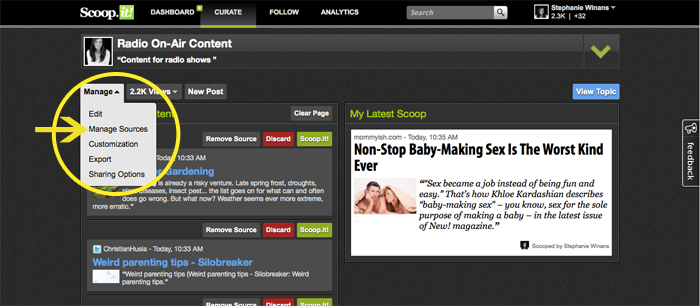
3. Add keywords for content that is relevant for your show. For example, relationships, sex, entertainment, parenting, family, music, weird. You can add keywords under the Manage tab under Manage Sources on your Scoop.It page (see image below).

4. Add sources. After adding your keywords, click the Advanced Options tab. Add the URL for any websites you normally use for show prep. You can also add social media accounts for any sources or shows you follow for content.

5. Scoop topics. When you’re prepping for the show, go to your Scoop.It page. Review Scoop.It ’s suggestions and scoop the topics you like.  

6. Follow other accounts on Scoop.It that produce content you can use on your show. You can follow mine here and check out the other shows and consultants I follow here. You can rescoop their topics so they appear on your page. You will also get a daily digest showing you recent scoops from topics you follow.


– written by Stephanie Winans


Happy scooping! Let me know if you enjoying using Scoop.It for show prep. Leave me a comment or send me a tweet @TheRandyLaneCo or @StephanieWinans If this doesn’t work for you, at least check out  Radio On-Air Content daily for topics you can use for your show. Why not? It’s free show prep.

Share this article

Recent Posts

By Randy Lane • September 29, 2026
When I start coaching a show, talents often say:“Nobody calls anymore.” Or: “Listeners in this market don’t call radio shows.” My response is, “That’s interesting, because several of our shows get more calls than they need.” The difference isn’t necessarily the market. It’s often how the show invites people into the conversation.  Airing callers and text […]

By Randy Lane • September 21, 2026
Jerry Seinfeld wrote every episode of Seinfeld longhand, on a yellow legal pad, with a blue Bic pen. He still writes that way. He’s said the flashing cursor on a screen makes him anxious, like it’s asking, “So, whaddaya got?” Why Start With Pen and Paper?Writing by hand slows you down just enough for ideas to […]

By Randy Lane • September 15, 2026
In the era of loud, fast-talking announcer DJs, my radio mentor, Todd Wallace, asked my fellow DJs and me, “Would you talk to your neighbor over the back fence like a pukey DJ or just in natural conversation?” Of course we all said we’d talk to them conversationally. Todd concluded, “Talk to listeners on air like […]
Show More