


How to Talk Dirty

Jeff McHugh • April 5, 2021

Almost no topic is off-limits in 2021, and talk involving relationships — dating, one-night stands, infidelity, sex — is hot in most radio format and podcast genres.

How  you talk about certain topics – the FCC defines them as  “sexual and excretory functions”  – can either make your show more compelling or generate complaints from the audience, advertisers, and your managers.

If your team debates what is “dirty,” it is no wonder. Even the FCC cannot define indecent content. Podcast and satellite radio hosts have fewer restrictions, but just because you  can  be more explicit, is it right for your brand?

Here are guidelines that may help your show navigate  content involving the human body from the neck down.

Use euphemisms and code words

Can you discuss content that parents might feel uncomfortable hearing with small children in the car? Yes. Avoiding adult-relevant topics to accommodate kids is a recipe for a boring show.

We suggest a vocabulary of substitute words when discussing acts and body parts. Words that adults grasp, but kids stay oblivious.

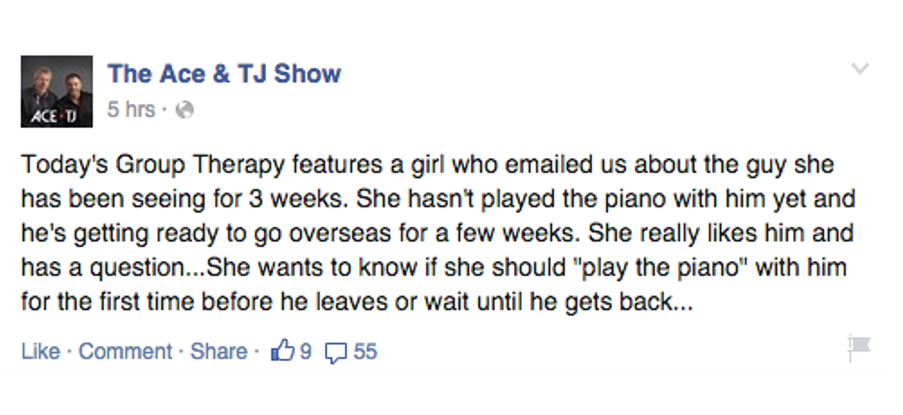
Ace and TJ  listeners know that “playing piano” has  nothing  to do with music “Playing piano” is said with a particular tone of voice to make the meaning clear.

I was at a world movie premiere where actor Mark Wahlburg did audience Q&A. When a fan asked what Wahlburg does to help the environment, he replied, “In our bathroom, the kids follow  “if it’s yellow let it mellow, if it’s brown, flush it down.”

Simultaneously the theatre laughed and emitted a loud, “ewww!” Dancing around certain descriptions can be more accepted than specific, vivid language. Saying that President Bill Clinton “left evidence” on Monica Lewinsky’s famous blue dress might be better than saying what the evidence was or how it got there.

Consider gender

If you saw the 2011 film, Bridesmaids you likely remember the  infamous food poisoning scene. The backstory is producer Judd Apatow insisted on adding the poop fest to the movie while Kristen Wiig and the other women in the movie strongly objected.

Male audiences found that scene funnier than females. Male audiences are generally not as offended by graphic content as are female listeners. With some guys, the more explicit it is the more they like it.

We are amazed how some male-targeted shows avoid being fined into oblivion, perhaps because a happy audience does not submit FCC complaints.

Also, we find that audiences are usually more accepting of a woman delivering explicit language than a man using the same verbiage.

Let lyrics be a guide

If your station plays music from artists like Megan Thee Stallion (with words bleeped out) your audience is likely more tolerant of adult language than if your station plays artists like Carrie Underwood.

Country and (obviously) Christian audiences expect cleaner conversations while Rock, Hip Hop and CHR listeners are not as easily offended.

Today’s top-performing radio and podcast shows are as unfiltered and personal to listeners as a real-life friendship. Like any friendship, your fans expect you to  know  their tastes well enough to choose words and language that suit them.

Photo by Josh Calabrese on Unsplash

Share this article

Recent Posts

By Randy Lane • September 29, 2026
When I start coaching a show, talents often say:“Nobody calls anymore.” Or: “Listeners in this market don’t call radio shows.” My response is, “That’s interesting, because several of our shows get more calls than they need.” The difference isn’t necessarily the market. It’s often how the show invites people into the conversation.  Airing callers and text […]

By Randy Lane • September 21, 2026
Jerry Seinfeld wrote every episode of Seinfeld longhand, on a yellow legal pad, with a blue Bic pen. He still writes that way. He’s said the flashing cursor on a screen makes him anxious, like it’s asking, “So, whaddaya got?” Why Start With Pen and Paper?Writing by hand slows you down just enough for ideas to […]

By Randy Lane • September 15, 2026
In the era of loud, fast-talking announcer DJs, my radio mentor, Todd Wallace, asked my fellow DJs and me, “Would you talk to your neighbor over the back fence like a pukey DJ or just in natural conversation?” Of course we all said we’d talk to them conversationally. Todd concluded, “Talk to listeners on air like […]
Show More