
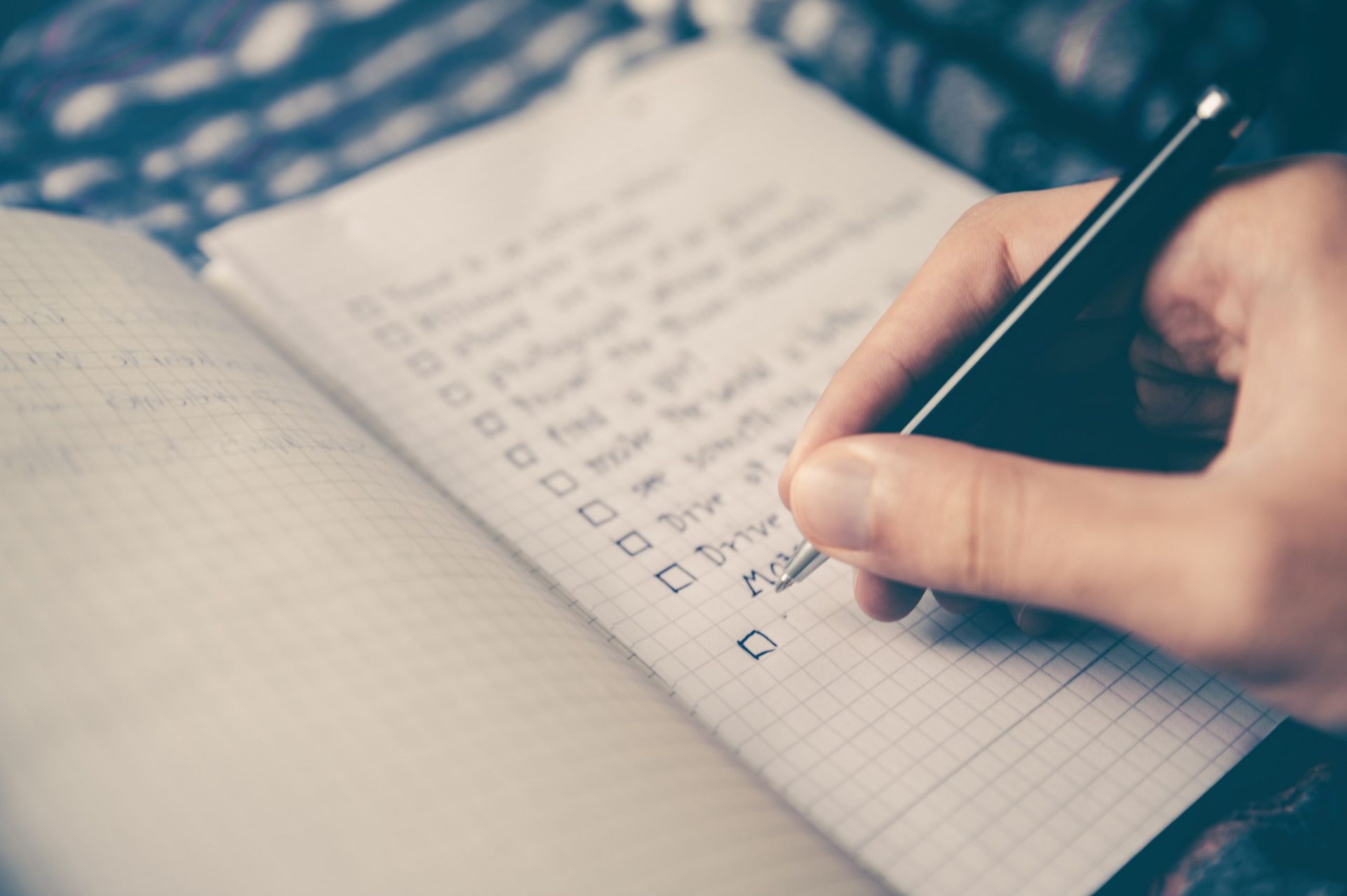

The Killer Show Checklist

Jeff McHugh • October 13, 2021

Randy Lane recently wrote about the one thing all great media presenters have in common:  planning .

Planning requires discipline, which is defined as “ training oneself to do something in a controlled and habitual way.” That’s why Randy followed up his planning article with one on  rituals .

What helps a person develop rituals? A  checklist .

Some things are too important to rely on memory. Surgeons, pilots, and rock stars setting up for concerts all use checklists.

Winning radio shows and podcasts use some version of a checklist. Here is one you can consider and customize to work for you.

PRE-SHOW CHECKLIST

  • Gather relevant breaking news and topics .
  • All players bring personal dilemmas  for content.
  • Prepare games  with trivia, sound, and prizes.
  • Plot the  whole  show.  Layout every segment before airtime. Deviate from the plan as needed.
  • Write out teases  for each segment and plan where you’ll air them.
  • Pull audio  clips, music, and sound effects for appropriate segments.
  • Do a “table read. ” Jerry Seinfeld and Larry David had a rule while producing Seinfeld: if they both laughed, it was usually a good joke for the show. Test each segment with your primary cast members. If the premise evokes  a reaction from all players  –it’s a go.

PRE-SEGMENT CHECKLIST

Review the plan for  each segment  with the  Execution Rule of Four.

  • Setup : How will you begin in a compelling way in under :08 seconds? (Tip: your tease for this segment often also works as a great setup.)
     
  • Payoff : What’s the high point of this segment? That’s your best exit. Determine as a team if the segment is worthy of one minute, two minutes, or more of airtime.
     
  • Point Of View : That includes opinions, thoughts, feelings, and stories from each player. Who has the strongest take – that person goes first in the mic order?
     
  • What Else?  Any tweaks that would take it from good to great?

POST-SHOW MEETING

  • High fives: What worked well  on today’s show or how did that segment work?
  • What didn’t work well  or why didn’t that break work well?
  • Why?  What would you do differently  next time?
  • What’s left over  that you didn’t get to that can go on tomorrow’s show?
  • Podcast:  What is the best segment of today’s show? That segment is the  first thing  people hear on the podcast. The second best segment goes at the end, and the hosts tease listeners to stick around for it.
  • Social Media:  What is coming up on the show in the next couple of days? What can we post today that evokes stories and content that we can use on the air later?

Share this article

Recent Posts

By Randy Lane • September 29, 2026
When I start coaching a show, talents often say:“Nobody calls anymore.” Or: “Listeners in this market don’t call radio shows.” My response is, “That’s interesting, because several of our shows get more calls than they need.” The difference isn’t necessarily the market. It’s often how the show invites people into the conversation.  Airing callers and text […]
By Randy Lane • September 21, 2026
Jerry Seinfeld wrote every episode of Seinfeld longhand, on a yellow legal pad, with a blue Bic pen. He still writes that way. He’s said the flashing cursor on a screen makes him anxious, like it’s asking, “So, whaddaya got?” Why Start With Pen and Paper?Writing by hand slows you down just enough for ideas to […]

By Randy Lane • September 15, 2026
In the era of loud, fast-talking announcer DJs, my radio mentor, Todd Wallace, asked my fellow DJs and me, “Would you talk to your neighbor over the back fence like a pukey DJ or just in natural conversation?” Of course we all said we’d talk to them conversationally. Todd concluded, “Talk to listeners on air like […]
Show More